8 Reasons Parma’s Food System Is One of the Most Sophisticated Technology Stories in Europe
The word “artisanal” gets used in food marketing to signal the absence of technology: handmade, unautomated, resistant to industrial process. It is almost always misleading. The most sophisticated food production systems in the world are not the ones that have avoided technology but the ones that have integrated it so completely into a traditional framework that the technology becomes invisible. You see the product and call it artisanal. You look at the supply chain, the quality control systems, the climate monitoring infrastructure, and the institutional design behind the certification process, and you see something that a technology journalist would immediately recognise as a serious engineering achievement.
Parma, in the Emilia-Romagna region of northern Italy, is the clearest example of this in food production. The city that produces Parmigiano-Reggiano cheese and Prosciutto di Parma ham has built a food system around these two products that involves precision fermentation science, robotic quality testing, IoT-monitored aging environments, and a geographic authentication system that solves the same supply chain integrity problem that blockchain technology is currently being applied to across multiple industries. A food tour through Parma is also a tour through one of Europe’s most interesting applied technology stories.
Here are eight reasons it belongs on the tech journalist’s travel list.
1. The DOP Certification System Is a Pre-Digital Provenance Blockchain
The Denominazione di Origine Protetta designation for both Parmigiano-Reggiano and Prosciutto di Parma is a geographic authentication system enforced by consortium inspection at every stage of production. Every wheel of Parmigiano-Reggiano is marked at birth with a casein plate bearing a unique serial number, the date of production, and the dairy’s identification code. At twelve months, an inspector from the Consorzio del Formaggio Parmigiano-Reggiano physically examines every wheel in the facility using a small hammer to tap the rind and listen for inconsistencies in the interior structure. Wheels that pass are hot-iron branded with the consortium mark. Those that fail are stripped of their marks and sold without the DOP designation.
This is a physical implementation of the same provenance verification logic that blockchain engineers are currently applying to food supply chains: an immutable record attached to a physical object at the point of creation, verified by a trusted third party at defined checkpoints, and marked in a way that makes post-hoc fraud detectable. The Parmigiano-Reggiano consortium has been running this system since 1934. The technology is different from a distributed ledger. The architecture is the same.
2. The Aging Caves Are Precision Climate Control Environments
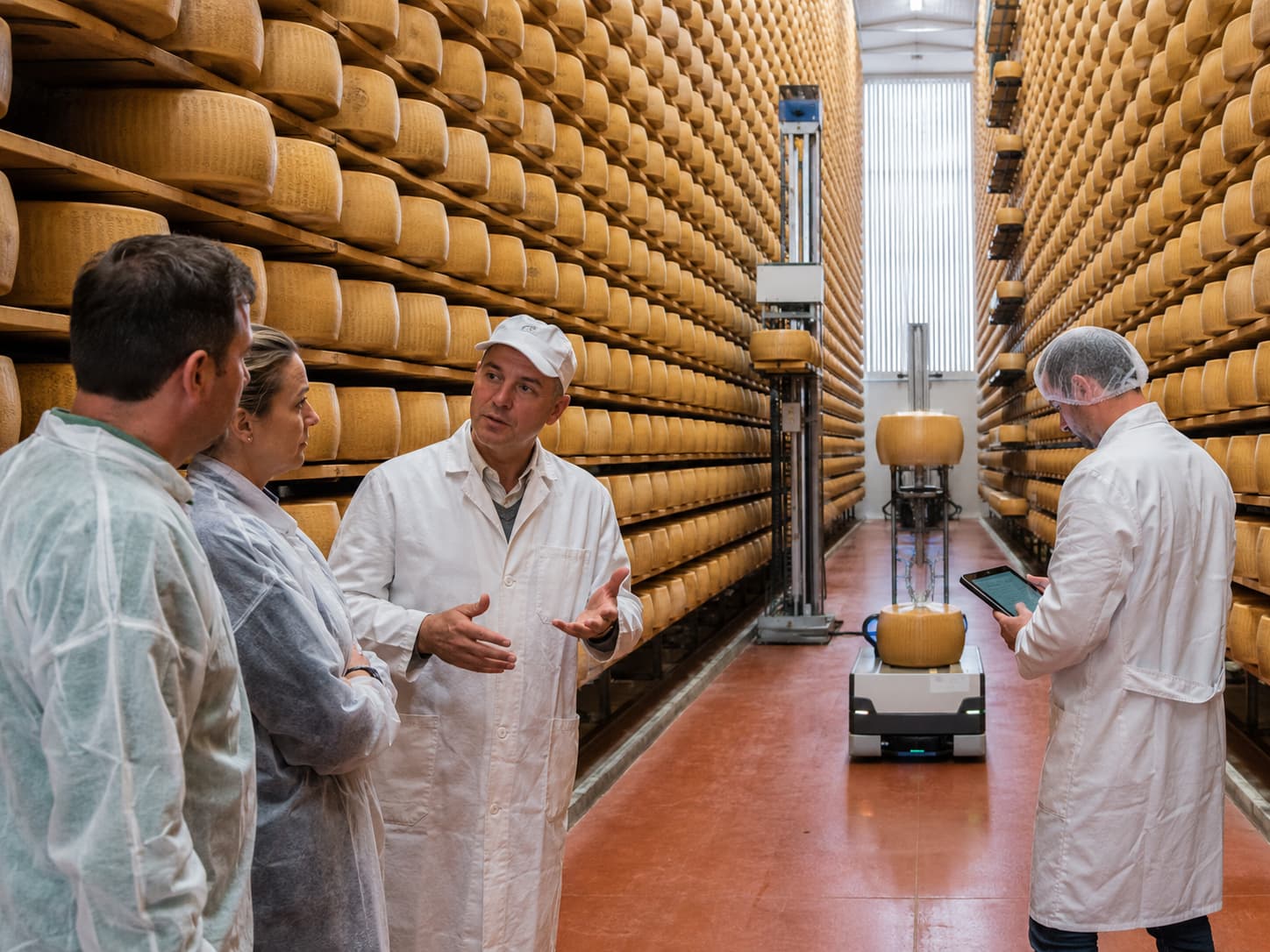
Parmigiano-Reggiano requires a minimum of twelve months of aging and is typically sold at twenty-four or thirty-six months. The aging environment is not a passive cellar. It is a controlled atmospheric system where humidity, temperature, and airflow are managed to produce the specific enzymatic activity that converts the young cheese’s texture and flavour profile into the crystalline, complex aged product. Modern Parmigiano-Reggiano facilities use sensor arrays to monitor conditions across thousands of wheels simultaneously, with automated alerts when any section of the aging room drifts outside the specified parameters.
The scale of this operation surprises most visitors. A single large facility may hold 100,000 wheels of cheese, each weighing around 40 kilograms, stacked on wooden shelving that extends to the ceiling of a warehouse-sized aging room. The environmental control required to maintain consistent conditions across that volume of product is not trivial engineering. It is the same kind of precision environmental management that pharmaceutical cold chain logistics require, applied to a food product that has been made in this valley since the Middle Ages.
3. The Prosciutto di Parma Salt Testing Robot Is an Industrial Engineering Story Worth Telling
The quality inspection of Prosciutto di Parma at the point of certification involves a specialist called a maestro salatore inserting a horse bone needle into five specific points of each ham and immediately smelling the needle after withdrawal. The olfactory assessment detects inconsistencies in the curing process that no instrument has yet matched for sensitivity and speed. The process is trained over years of apprenticeship and is considered the bottleneck in the consortium’s inspection capacity.
What is less widely reported is that the consortium has been working with food technology researchers to develop automated olfactory sensing systems that could supplement the maestro salatore’s capacity without replacing the human judgment that makes the assessment reliable. This is the same human-machine complementarity problem that appears in medical imaging AI, in materials inspection, and in any quality control domain where trained human sensory evaluation remains ahead of sensor technology. Parma is running a live version of this problem in one of the most unusual applications a tech journalist is likely to encounter.
4. The Milk Supply Chain for Parmigiano-Reggiano Is a Precision Agriculture Story
Every wheel of Parmigiano-Reggiano must be made from milk produced by cows within the defined production zone, fed on locally grown or produced feed under consortium-specified nutritional guidelines. The milk must be delivered to the dairy within two hours of milking. Each batch of cheese is produced from the evening milk of the previous day, partially skimmed by natural separation overnight, combined with the full-fat morning milk, and inoculated with whey starter culture from the previous day’s production in a closed-loop fermentation system that maintains the microbial continuity of each dairy’s unique culture.
This is precision agriculture and supply chain management operating at a level of specificity that most industrial food systems only approach through regulatory requirement. The traceability from individual cow to finished wheel, through a supply chain with sub-two-hour transit times and a fermentation process that is deliberately self-referential in its culture management, is the kind of system that food technology researchers study as a model for what sustainable, high-quality, geographically bounded production can look like at commercial scale. The technologies shaping the future of food production increasingly look like what Parma’s consorzio has been running for decades.
5. The Culatello Production Process Is Humidity Engineering in an Unusual Setting
Culatello di Zibello, a cured pork product from the Po river plain west of Parma, is produced in the fog-prone lowland environment of the river valley using the naturally high winter humidity of the area as a critical component of the curing process. The product cannot be made outside this specific microclimate, not because the recipe is secret but because the atmospheric conditions that produce the correct rate of moisture exchange through the casing during curing cannot be replicated elsewhere without energy-intensive climate simulation that would change the economics of production entirely.
This is geography as process parameter: a specific set of atmospheric conditions integrated into a production system in a way that makes them irreplaceable. It is the same principle that makes certain semiconductor fabrication processes location-specific, or that makes certain pharmaceutical fermentation processes sensitive to the mineral content of the local water supply. The terroir concept in wine and food is not mysticism. It is the acknowledgment that some process variables are geographically fixed and that the product they produce cannot be fully separated from the place that makes them available.
6. Guided Food Tours Navigate the Production System That Independent Visitors Miss
The Parmigiano-Reggiano dairies that accept visitors are typically small operations that have made a decision to open their production process to tourism as a secondary revenue stream. Finding them, booking access, and navigating the timing around the early morning production schedule (the cheese is made before most tourists are awake) requires local knowledge and advance coordination that most independent visitors don’t manage effectively.
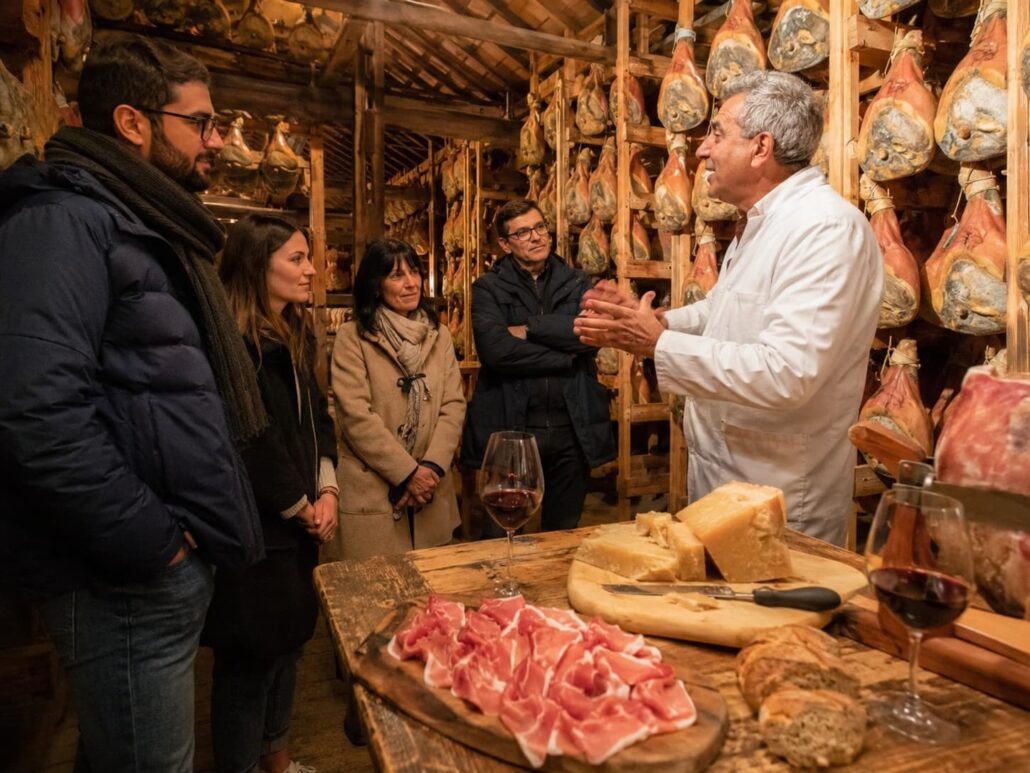
Operators like Parma Food Tours structure access to the full production chain: early morning dairy visits to see the cheesemaking process, aging facility tours with an experienced guide who can explain the quality control system, prosciutto production facility visits, and culatello cellars in the Po valley lowlands. For tech journalists and researchers whose interest in Parma extends to the production technology rather than just the product, this kind of structured access to the operational reality of the food system covers significantly more ground than independent restaurant visits alone.
7. The Consortium Governance Model Is an Institutional Design Case Study
Both the Consorzio del Formaggio Parmigiano-Reggiano and the Consorzio del Prosciutto di Parma are producer-owned organisations that set production standards, conduct quality inspections, manage the certification mark, and enforce the DOP designation through legal action against producers who violate the rules or retailers who misrepresent inferior products under the protected name. They are self-regulating industry bodies with enforcement authority delegated by the Italian state and backed by European Union intellectual property law.
The governance model that makes this work, producer ownership of the standards body, mandatory inspection at defined checkpoints, graduated sanctions for non-compliance, and international legal enforcement through the EU framework, is the kind of institutional design that technology policy researchers study when thinking about how to govern decentralised systems. The parallels to platform governance, to open-source project management, and to the emerging governance debates around AI development standards are not exact but they are instructive. As our coverage of technologies shaping the modern world notes, the governance problems that new technologies create are often older than the technologies themselves, and Parma’s consorzio model has been solving a version of the same problem for nearly a century.
8. Parma’s Food System Demonstrates What Geographic Locking Does to Product Quality
The argument for geographic indication protections in food, the legal framework that protects names like Parmigiano-Reggiano, Champagne, and Prosciutto di Parma, is fundamentally a quality argument rather than a commercial one. The claim is that the specific combination of geography, microclimate, biological culture, and accumulated production knowledge that exists in a particular place produces a product that cannot be replicated elsewhere, and that allowing the name to be applied to products made outside that context degrades the information value of the name to consumers.
This is an information systems argument. The name is a data compression: it encodes a specific set of production conditions and quality characteristics into a word that consumers can act on without needing to verify the underlying production chain themselves. Diluting the name by allowing inferior products to carry it is the food equivalent of a man-in-the-middle attack on a trusted certificate: the certificate remains valid in form while the underlying authentication has been compromised. Parma’s consorzio system exists to prevent exactly this attack, and it has been doing so with a combination of physical inspection, legal enforcement, and market reputation management that a cybersecurity engineer would find methodologically familiar. Understanding the system in person, by visiting the production facilities and the consortium inspection process, makes the information architecture behind it legible in a way that reading about it does not.
A Final Thought
The most interesting technology stories are often the ones where the technology is invisible because it has been fully integrated into a human practice that predates it. Parma’s food production system is exactly this: a set of techniques developed over centuries, progressively augmented by precision measurement, environmental control, robotic inspection, and institutional design, until the whole system runs at a quality and consistency that looks like tradition but is actually the result of continuous technological investment.
A food tour through Parma is not a break from the technology beat. It is a field visit to one of the most successful cases of technology integration in European manufacturing, wrapped in prosciutto and aged for thirty-six months.
The Parmigiano-Reggiano at the end of the aging facility tour tastes better than anything you will buy at home. That is also part of the story.